
National Institute of the Republic of Serbia

ὅδε οἶκος, ὦ ἑταῖρε, μνημεῖον ἐστιν ζωῶν τῶν σοφῶν ἀνδρῶν, καὶ τῶν ἔργων αὐτῶν
Text prepared by Dr Marija Šegan-Radonjić, Secretary of the Archive
The Archives of the Mathematical Institute of SASA comprises a complex and diverse body of materials that brings together institutional administrative records and scientific documentation. These documents trace the development of mathematics and related disciplines in Serbia from the Institute’s founding in 1946 to the present day.
Until recently, the Archives of the MISASA was not formally recognized as a separate organisational unit; rather, it was considered part of the Institute’s administrative operations. Archival materials were managed by the Secretariat and Accounting Department, which oversaw legal, personnel, and administrative affairs in accordance with relevant regulations and the guidelines of the State Archives. It is assumed that during the Institute’s early years, this role was handled by the Secretariat of the Institute and the relevant services of the Serbian Academy of Sciences, of which the Institute was a part from 1946 to 1961.
Even after the adoption of the Law on Independent Financing in 1954, the Institute continued to rely on the Academy’s services, as it did not have its own accounting department. This is evidenced by the fact that in 2023–2024, administrative documentation of the Institute for the period 1954–1968 was transferred from the Archives of SASA.
For the first time, the 2021 Regulation on Internal Organisation and Job Systematization established the positions of Head and Secretary of the Archives of the MISASA within the organisation of the Institute’s scientific work, thereby granting archival activities an official place in the institutional structure.
Currently, the administrative archive is under the jurisdiction of the State Archives of Serbia. It is stored in several rooms of the Institute, but in 2025, specialized archival cabinets were purchased to consolidate the majority of the collection in one location, as far as the available space allows. Part of the material has been inventoried and classified in the archival register (1946–2023), indicating that the collection consists of more than 500 archival units.
The materials are diverse in form, including books, folders, binders, and notebooks. In terms of content, they include legal, personnel, financial, and administrative documentation, such as statutes, founding documents, registry logs, contracts, payroll lists, financial statements, reports, public procurement records, and accreditation documents. In addition, the collection contains a significant body of scientific and professional documentation, including minutes of meetings of governing and scientific bodies, project contracts, correspondence with ministries, and materials relating to international cooperation, conferences, and seminars.
A useful starting point for research can be found in documents published in the Institute’s publications and on its official website. However, the digital copies available there mostly contain titles only, without additional metadata or descriptive elements, which makes them difficult to search. Particularly noteworthy is the digitisation project carried out in 2018, during which part of the archival materials from the period 1946–1961 were processed and published in the Institute’s Digital Archive. As the primary goal was to present the content for research purposes, working copies intended for online publication were created, rather than master copies for long-term preservation.
Unlike the administrative documentation, the scientific materials produced by the Institute members have not yet been fully systematized. So far, only the archive of Academician Dragoš Cvetković, which was entrusted to the Institute for permanent safekeeping in 2012, has been thoroughly processed. This collection includes teaching materials and notes in mathematics, documentation on collaborations with universities, extensive records on national and international projects (federal and European programmes), as well as manuscripts, correspondence, and working materials created in collaboration with prominent mathematicians and colleagues.
The existence of other personal collections — such as those of academicians Vojislav Mišković (1892–1976) and Miloš Radojčić (1903–1975) — as well as other types of scientific materials, such as lithographed lecture notes by professors of mathematics at the Great School and the University of Belgrade, is documented in papers published in the journal NCD Review.
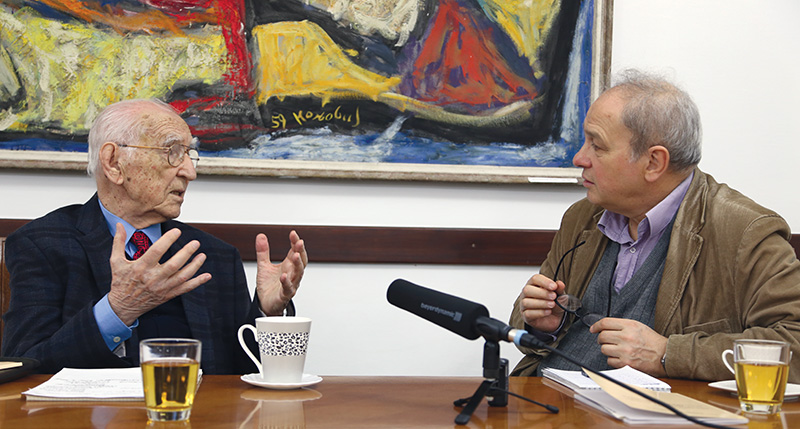
A special segment of the archival heritage of the MISASA consists of initiatives aimed at preserving the memories of distinguished scientists through audio and video interviews. The idea of recording these interviews grew out of activities undertaken in the 1990s. Between 1994 and 1996, Dr Rade Dacić (1930–2016), who was then head of the Seminar on the History and Philosophy of Mathematics at the Institute, organised a series of conversations with prominent scientists in the fields of mathematics and related disciplines, in collaboration with the Museum of Science and Technology in Belgrade. Some of these conversations were recorded on audio cassettes, which are now preserved in the Institute’s archives.
In 2020, in collaboration with the Institute of Musicology SASA, these recordings were digitised to preserve the originals and make them accessible to the broader scientific community. The official website of the Institute features the memories of five scientists: Nenad Janković (1911–1997), Miodrag Tomić (1912–2001), Viktor Soljnikov (1927–2006), Bogoljub Stanković (1924–2018), and Slaviša Prešić (1933–2008).
|
|
Conversation between Academician Bogoljub Stanković and Professor Žarko Mijajlović, |
Building on this initiative, in 2016, professors Žarko Mijajlović and Zoran Ognjanović launched an internal institutional project called Interviews with Mathematicians in Serbia. They organised a series of video interviews with long-standing collaborators and members of the Institute. Among the interviewees were Academicians Nikola Hajdin (1923–2019), Bogoljub Stanković, Dragoš Cvetković, and Zoran Knežević, as well as professors Veljko Vujičić (1929–2020), Koriolan Gilezan (1929–2023), Nedeljko Parezanović, Branka Alimpić, Zoran Marković (1948–2025) and Rade Živaljević. The unedited video material from these interviews is currently preserved in the Institute’s archives.
The Archives of the MISASA serve as a unique link between administrative documentation, scientific heritage, and intangible testimonies of the development of mathematics and related disciplines in Serbia over more than eight decades. In addition to preserving the institutional memory of the Institute’s formation and operations, the Archives contain exceptionally valuable sources for studying scientific processes, research projects, international collaborations, and the individual contributions of distinguished scholars.
Systematizing, digitising, and properly presenting this material to both the academic community and the general public is crucial for advancing research on the history of science in Serbia. These processes ensure the preservation and enhancement of a rich archival legacy, stimulate new interdisciplinary research, and contribute to a deeper understanding of the role of the Mathematical Institute of SASA in the advancement of mathematics, natural sciences, and technical disciplines in both national and international contexts.
|
|
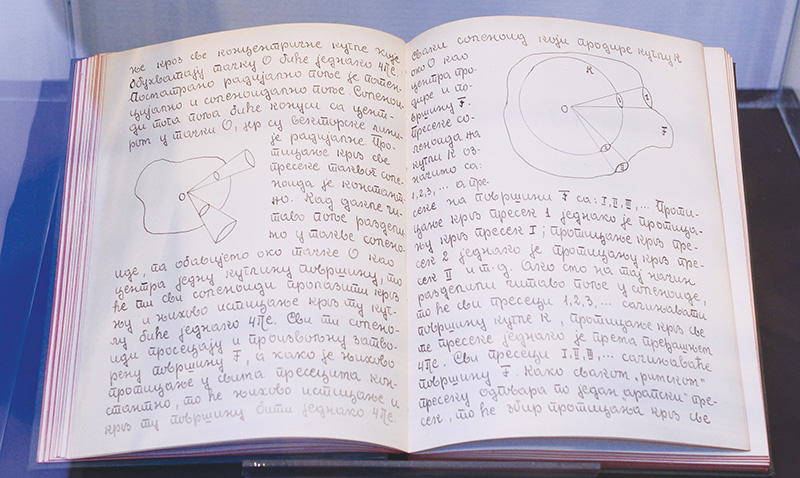
Notes by student Borivoje J. Pujić from professor Milutin Milanković’s lectures held in 1910–1914, MISASA Archives |