
National Institute of the Republic of Serbia

ὅδε οἶκος, ὦ ἑταῖρε, μνημεῖον ἐστιν ζωῶν τῶν σοφῶν ἀνδρῶν, καὶ τῶν ἔργων αὐτῶν
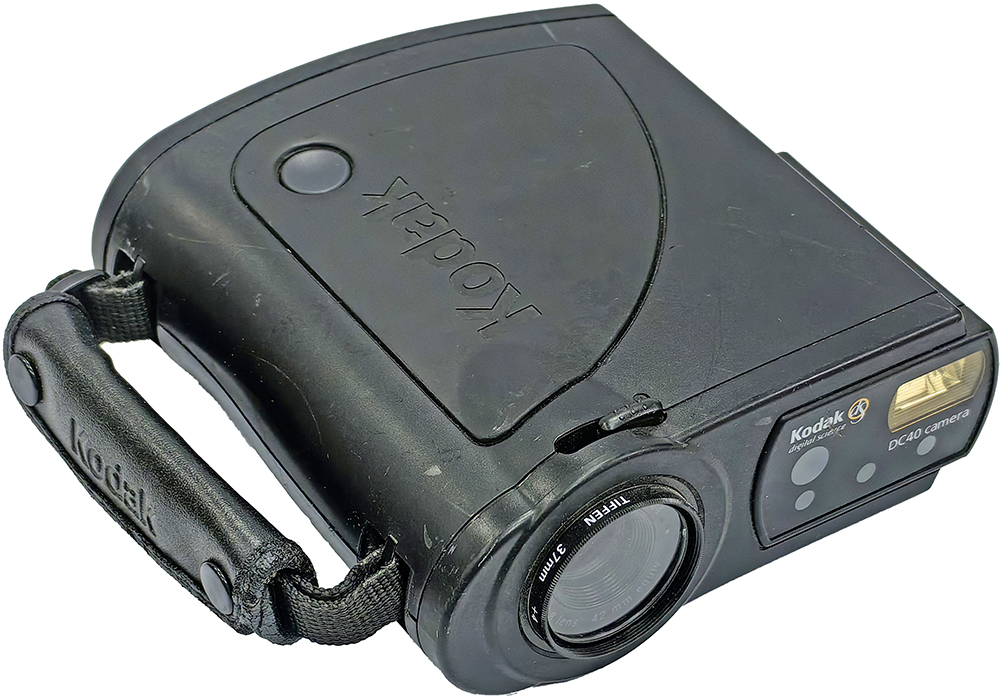
The Kodak DC40, developed by Eastman Kodak, was introduced on March 28, 1995, and is considered one of the first digital cameras designed for general consumer use. This model marked a significant moment in the history of photography—transitioning from film to digital image recording, making digital technology accessible to everyday users. The DC40 featured a 0.38-megapixel CCD sensor (effectively about 0.4 MP) with a resolution of 756 × 504 pixels, which allowed users to create color photographs sufficient for on-screen viewing and basic printing. The camera had a fixed 42 mm lens (35 mm equivalent), a built-in flash, 4 MB of internal memory, and was connected to a computer via an RS-232 serial port. Photos were transferred to a computer and converted into formats such as TIFF and PICT. Although it lacked an LCD screen for previewing images, the DC40 offered a new experience: the ability to capture, store, and process images without film, eliminating the wait time for development. The camera supported basic image capture functions without zoom or manual settings, which made it very user-friendly. Technical Specifications:
Creator: Eastman Kodak, 1995
Source: Mathematical Institute SASA
Text prepared by Vanja Korać
Photo by Dragan Aćimović